
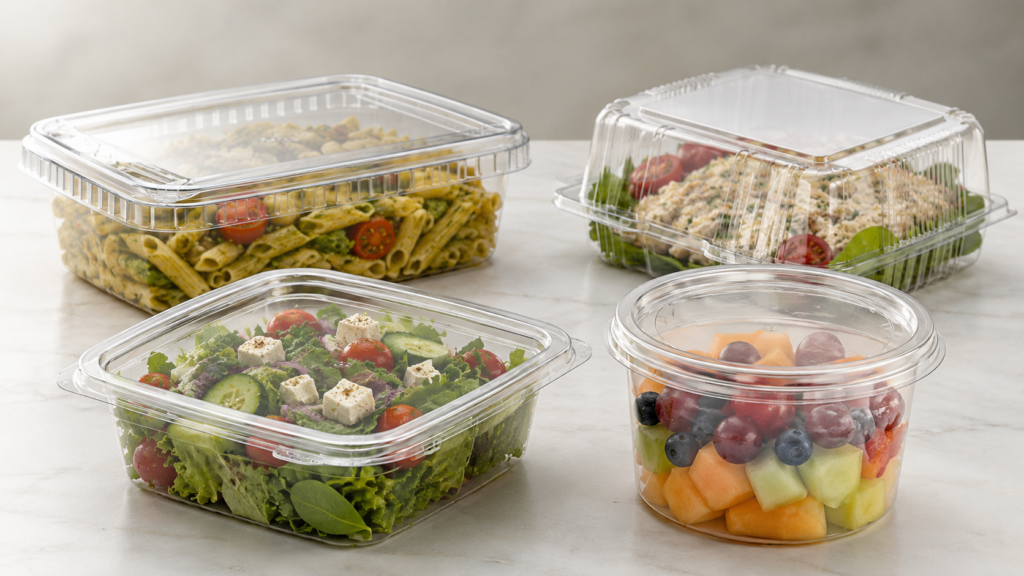
Tamper-evident food containers offer an advantage that standard containers cannot always provide: a visible sign showing whether the packaging has been opened after it was sealed.
This is particularly useful when food has to travel a certain distance before reaching the customer. Takeaway, delivery, catering, ready meals and pre-packed products for display are just some examples of situations where the integrity of the closure can become part of the customer experience.
However, not all closure systems work in the same way, and not every service needs a tamper-evident seal. Terms such as airtight closure, tamper-evident packaging and security seal should not be confused either, even though some containers can combine several of these features.
In this guide, we explain how these containers work, what benefits they offer and what to consider before choosing them.
What is a tamper-evident food container?
A tamper-evident food container includes a system designed to leave a visible sign after the first opening.
Depending on the model, this may be a tab, strip or perimeter section that breaks or comes away when the container is opened for the first time.
For this reason, these products are also commonly referred to as tamper-evident containers or containers with a security closure.
However, “tamper-evident” does not mean that the container is physically impossible to open. The purpose of the system is to make any previous opening easy to detect.
This allows the customer to receive their food and visually check that the safety system has remained intact since the order left the premises.
How do tamper-evident food containers work?
The principle is simple, and that simplicity is one of their main advantages.
Once the container has been filled and the lid has been correctly positioned or pressed into place, the safety system locks. To access the contents for the first time, the part acting as the seal must be broken, removed or visibly altered.
After that first opening, the change remains visible.
The process can be divided into three stages:
1. Closing the container
The food is placed inside the container, which is then closed according to the intended system.
It is important to apply enough pressure around the entire edge and check that the lid and base fit together correctly. In some models, the closure and seal are part of the same system; in others, the container and lid are two separate but compatible components.
2. Transport or storage
As long as the seal remains intact, the recipient can visually check that the first-opening system has not been broken.
In models that combine a tamper-evident seal with an airtight closure, the container may also help reduce the risk of leaks during transport. The PET tamper-evident containers currently available from Monouso, for example, feature a hinged lid, an airtight closure and a perimeter seal designed to reveal any previous opening.
3. First opening
To access the food, the safety mechanism must be broken.
After that, the container may be reclosed if its design allows it, but it no longer provides the same proof of first opening, because the original seal has already been broken.
Tamper-evident seal and airtight closure: are they the same thing?
No, and this distinction is important when choosing a container.
A tamper-evident seal is mainly designed to show whether the packaging has already been opened.
An airtight closure, on the other hand, is intended to keep the container securely closed and reduce the risk of spills or leaks.
A container may combine both functions, but you should not assume that every tamper-evident container is automatically suitable for transporting liquids, or that every airtight container will show whether it has previously been opened.
For this reason, when buying packaging for your business, always check the technical specifications of each product and do not rely solely on the appearance of the lid.
What are the benefits of tamper-evident food containers?
The first benefit is clear: they add an extra visual check during the journey between the business and the customer.
But their usefulness goes further.
They help build trust
With a delivery order, the customer cannot see what happens between the moment the meal leaves the kitchen and the moment it arrives at their door.
Receiving a container with the safety system still intact provides a simple visual indication of the condition of the closure.
They are particularly useful during transport
Many of these models are specifically designed for takeaway food.
When the tamper-evident seal is combined with a good closure system, the container can offer a practical way to transport food while reducing the risk of accidental opening.
They support a professional presentation
A transparent, properly closed container helps present the product neatly and can convey a greater sense of care and quality.
This is especially important for ready meals, display counters, catering and businesses where the packaging itself forms part of the final presentation.
They suit different quantities and preparations
Not every product needs the same size of container.
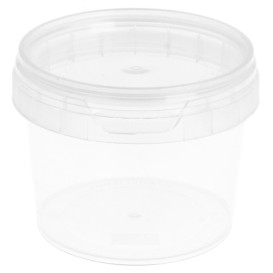
There are small containers for sauces, dressings or samples, medium formats for individual portions and larger capacities for ready meals or dishes designed for sharing.
Monouso’s current range includes different sizes and formats of tamper-evident food containers.
When is it worth choosing tamper-evident food containers?
Not every service needs the same level of closure security. Before choosing, it is useful to think about what happens to the food between the moment it leaves the kitchen and the moment it reaches the customer.
Delivery
This is probably one of the most obvious applications.
An order goes through several stages before reaching the customer: preparation, collection, transport and delivery. A seal integrated into the container makes any first opening visible.
In addition, when the system is already built into the packaging, there is less need to use stickers or other external sealing elements on every individual container.
Takeaway
Even if the journey is usually shorter, this type of container can still be useful when you want to hand the customer a closed meal that is ready to transport.
It is particularly practical for ready meals, portioned products or businesses with display counters for takeaway food.

Sauces, dressings and liquid preparations
Here it is important to distinguish between two aspects: first-opening security and leak resistance.
If you need to transport a sauce, cream or preparation containing liquid, a seal alone is not enough. You should also check that the model is suitable for that type of content and provides adequate protection against leaks.
Catering and events
When food is prepared in one place and consumed elsewhere, keeping it properly closed during transport is particularly important.
Tamper-evident formats can be used for individual portions, desserts, side dishes, sauces or other preparations that need to remain packed until serving.
Ready meals and display presentation
They can also be useful when food remains pre-packed before sale.
As well as the functionality of the closure, transparent containers allow the product to remain visible, which is particularly useful in display cabinets and on counters.
PET or PP: which material should you choose?
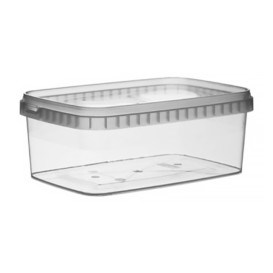
Tamper-evident containers are available in different materials. In Monouso’s current range, PET and PP (polypropylene) are particularly important.
The choice should not be based on appearance alone.

PET tamper-evident containers
PET stands out mainly for its transparency, allowing the contents to be clearly seen.
It is very suitable for cold preparations, ready meals, salads, bakery items, fruit, snacks and other foods where you want the customer to see the product clearly.
However, temperature must be taken into account: Monouso’s PET tamper-evident models are not intended for heating in the microwave.
PP tamper-evident containers
Polypropylene offers other possibilities. Some products can be used with both cold and hot food and, in certain cases, may also be microwave-safe.
For example, some PP models in Monouso’s current range are specifically indicated as suitable for microwave use.
In all cases, the most important rule is simple: always check the technical data sheet for the specific container and make sure it is suitable for food contact. The fact that a material can withstand certain temperatures does not mean that every product made from that material has exactly the same conditions of use.

Flat lid or high lid?
The height of the lid can significantly affect how useful the container is.
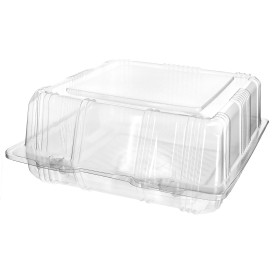
A flat lid is suitable when the food stays within the height of the container itself and you want to optimise space during storage and transport.
A high lid provides extra room at the top and may be useful when the presentation needs more height, when the food rises slightly above the rim or when you want to prevent the lid from sitting too close to the product.
The choice depends more on the dish than on the safety system itself.
A bulky salad, certain bakery products or a dish with more height may require a different format from a compact or flat portion.
How do you choose the right size?
Choosing a container that is “slightly bigger just in case” is not always the best approach.
A container that is too large can allow the food to move around too much during transport and may also make the portion look smaller.
On the other hand, a container that is too small can make it difficult to close properly and may even affect how the lid works.
Before choosing, consider:
- the actual volume of each portion;
- whether the food contains sauce or liquid;
- how much space is needed above the food;
- whether it will be transported hot or cold;
- how the container will be positioned in the delivery bag;
- whether the containers need to be stacked;
- and how you want the customer to experience the product when opening the order.
Ideally, test the container with the actual dish, rather than relying only on the stated capacity in millilitres.
5 checks to make before choosing your container
Before introducing a new model into your service, it is worth carrying out a few simple tests.
Check the seal. Close and open the container yourself. Evidence of opening should be easy to identify.
Test the closure with your recipe. If you use sauces or foods containing liquid, carry out a real transport test and check the leak resistance.
Check the temperature range. Especially if you plan to heat, chill or freeze the container.
Check stackability. A good container should still perform properly when several orders are placed in the same bag.
Assess the opening experience. The customer should be able to understand easily how to access the food without the packaging becoming unnecessarily difficult to open.
Common mistakes when using tamper-evident containers
One of the most common mistakes is assuming that a tamper-evident seal automatically means the container is airtight or leakproof. As we have seen, these are related but different features.
Other mistakes to avoid include:
- using a material at temperatures for which the specific product was not designed;
- overfilling the container and preventing it from closing correctly;
- choosing the capacity without first testing a real portion;
- using a lid that does not match the container exactly;
- failing to test how the container performs during an actual delivery journey;
- assuming that the seal keeps its original function after the first opening.
A good container should not be chosen from a catalogue alone. It should be tested under the real conditions of your service.
Frequently asked questions about tamper-evident food containers
Is a container with a tamper-evident seal always airtight?
Not necessarily. The seal is designed to show whether the container has been opened, while leak resistance depends on the closure system. Some models combine both functions.
Can they be used in the microwave?
It depends on the material and the model. Some PP containers may be microwave-safe, while other materials, such as certain PET containers, are not intended for heating. Always check the technical data sheet for each product.
Are they suitable for delivery?
Yes, particularly when you want the customer to be able to visually check that the container has not been opened during transport. However, it is still important to choose the right capacity, material and closure type for the food.