
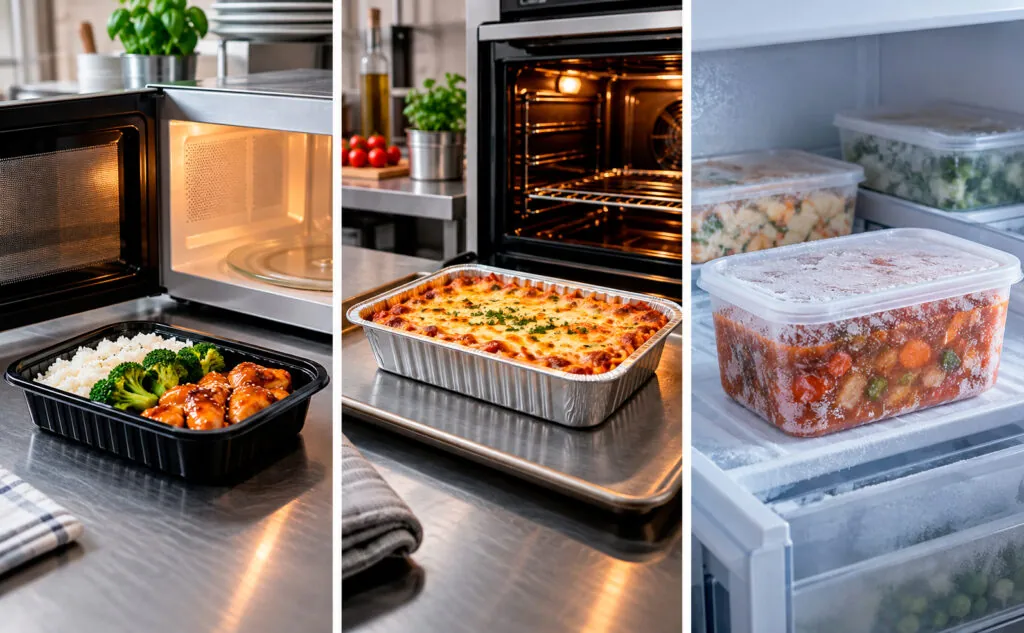
Choosing delivery packaging by temperature is essential when prepared food may pass through different conditions before reaching the customer. The same dish may leave the kitchen hot, travel for several minutes, be kept refrigerated, frozen or require reheating later in a microwave or oven.
For businesses offering takeaway, delivery, catering and prepared meals, choosing packaging based only on size, material or design may therefore not be enough. It is also important to consider how the food will be stored, transported and reheated.
Will the customer need to put it in the microwave? Does the dish need to go in the oven? Will it be frozen? Will it be eaten straight away or several hours later?
The key is to consider the type of food, temperature, storage method and way it will be consumed in order to choose the right container for each situation.
Choose the packaging based on the food journey first
One of the most common mistakes when selecting professional food packaging is starting with the material.
“I need a plastic container.”
“I want to use cardboard.”
“I prefer aluminium.”
For a professional business, it is usually more useful to approach the decision the other way around: first define what will happen to the food, then choose a material that can meet those requirements.
Define what will happen before, during and after delivery
Before choosing a container, consider the entire journey of the dish.
For example:
Kitchen → packing → delivery → customer → microwave.
Or:
Preparation → packing → freezing → storage → sale → defrosting → oven.
It could also simply be:
Cold preparation → refrigeration → delivery → direct consumption.
These are very different processes and may require food packaging with different properties.
Before making a decision, it is worth asking questions such as:
- Is the food placed in the container while still hot?
- Does it need to cool before the container is closed?
- Will it be kept refrigerated?
- Will it be frozen?
- Will the customer need to reheat it?
- Will they use a microwave, oven or both?
- Will the food be eaten directly from the container?
- Does it contain fat, sauce or liquids?
- How long will the food remain inside the container?
The clearer this journey is, the easier it becomes to narrow down the available packaging options.
The same food may require different packaging depending on the service
Consider a portion of pasta.
If it is served immediately at an event, it has one set of requirements.
If it needs to travel for thirty minutes as part of a delivery order, other factors become important, including closure, heat retention and stability during transport.
And if it is sold as a chilled ready meal to be reheated at home, compatibility with the reheating method becomes even more important.
The food itself may be exactly the same.
What changes is how it is prepared, stored, transported and consumed.
That is why choosing delivery packaging by temperature means analysing the entire service rather than just the food inside the container.
Microwave-safe delivery packaging: when the customer needs to reheat the meal
Microwave-safe food containers can be particularly useful for restaurants and businesses selling prepared meals, office lunches, scheduled delivery services or dishes that customers may eat several hours after receiving them.
Being able to reheat the meal directly in its container simplifies the customer experience and avoids the need to transfer the food into another dish.
However, not all packaging performs in the same way during this type of use.
Not all plastic packaging is microwave-safe
The term “plastic” is too broad.
There are different types of plastic, each with its own properties and conditions of use.
Polypropylene, or PP, is one of the materials commonly used for containers designed for hot food and certain microwave reheating applications.
However, this does not mean that every PP container can automatically be used under the same conditions.
The design, thickness, manufacturing process and conditions of use specified by the manufacturer can all vary.
For a professional business, the right question should therefore not be:
“Is PP microwave-safe?”
Instead, ask:
“Is this specific container suitable for microwave use under the conditions required by my service?”
Always check the technical data sheet or product specifications.
The lid is also part of the system
Checking the base alone is not enough.
In many containers, the base and lid are made from different materials and may therefore have different conditions of use.
The fact that the base is microwave-safe does not necessarily mean that the lid should remain in place during reheating.
Steam also needs to be considered.
Rice, pasta, stews and dishes with sauces can generate a significant amount of steam while reheating.
Depending on the container, it may therefore be necessary to remove the lid, leave it partially open or use the packaging in a particular way.
Instructions should be clear for both the business and the customer.
Easier reheating improves the eating experience
For some business models, it can be particularly convenient for the same container to accompany the food through several stages:
receive → store → reheat → eat.
This reduces handling and simplifies the service.
It can be especially useful for:
- Office meals.
- Prepared dishes.
- Rice and pasta dishes.
- Pulses.
- Stews.
- Meals with sauces.
- Weekly meal plans.
- Prepared meal delivery services.
In these cases, the container is no longer simply used to transport food. It becomes part of the final eating experience.
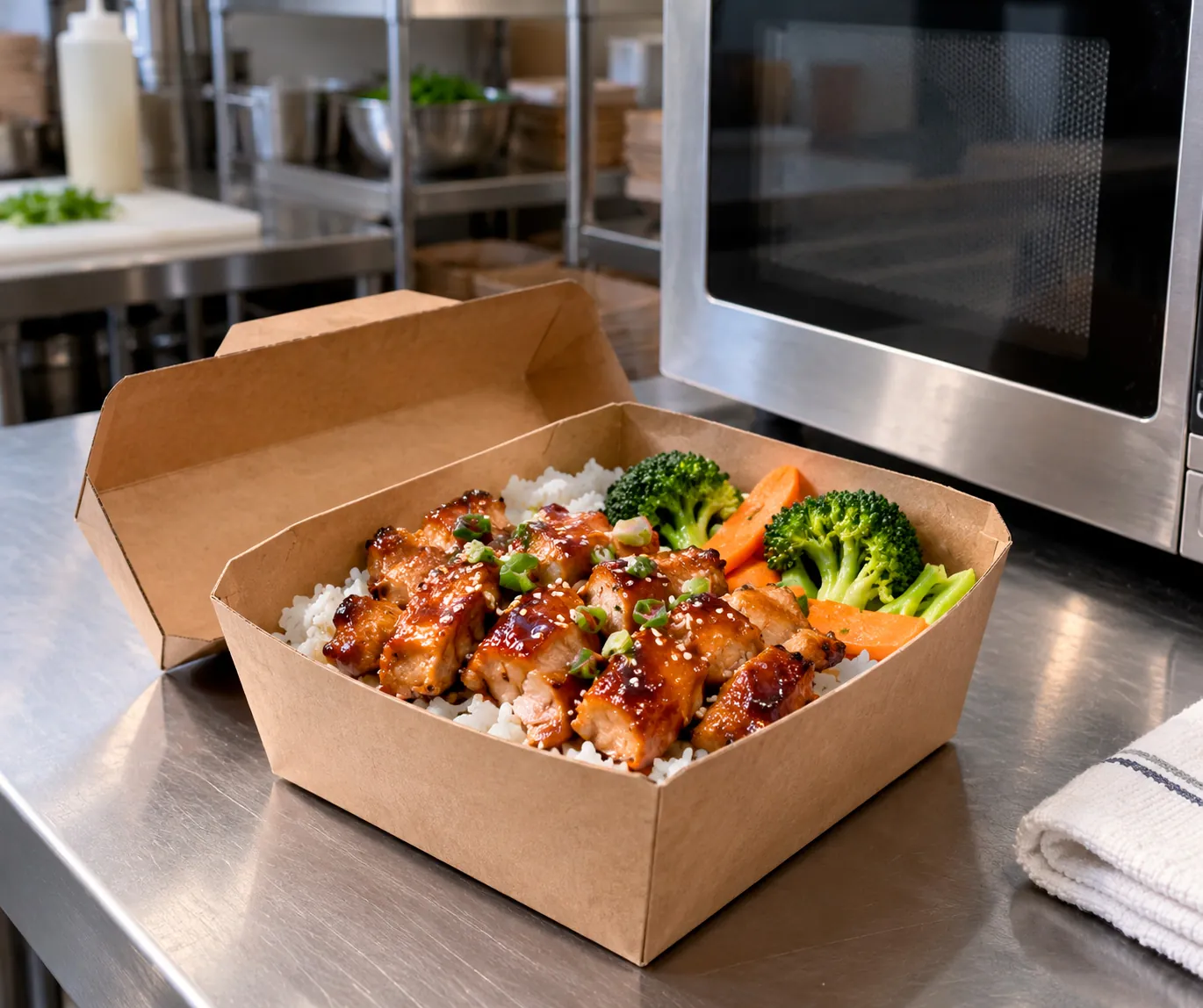
Delivery packaging and oven use: what should you check first?
When it comes to ovens, there is an important distinction to make.
A container being able to hold very hot food does not mean that it is designed to remain inside an oven.
Suitable for hot food does not mean oven-safe
Freshly cooked food can be placed in certain heat-resistant containers.
However, spending several minutes inside an oven creates a different type of thermal exposure.
The temperature, duration and way in which the heat affects the container are different.
You should therefore never assume that:
“Suitable for hot food” = “Oven-safe”.
If the container is to be used for cooking, regenerating, reheating or gratinating food, it must be specifically designed for that purpose.
Aluminium is commonly used for certain oven applications
Aluminium trays for prepared food are widely used by catering companies, rotisseries, production kitchens, bakeries and hospitality businesses where food may need to go into the oven.
Lasagne, cannelloni, roasts, gratins and certain baked products are common examples.
One operational advantage can be the ability to simplify part of the process:
prepare → cook → transport → deliver.
Even so, it is always necessary to check the exact conditions of use of the specific product.
This is particularly important if the packaging includes lids, coatings or components made from other materials.
Some cardboard and fibre containers also have specific thermal uses
Packaging made from cardboard, paper and plant fibres has evolved considerably, and there are now containers designed to withstand certain thermal conditions.
However, the same rule still applies:
the material alone does not determine how the packaging can be used.
Two containers that look very similar may have different compositions, coatings and temperature limits.
If you need to use a cardboard or fibre container during a heating process, always check the specifications of the exact product.
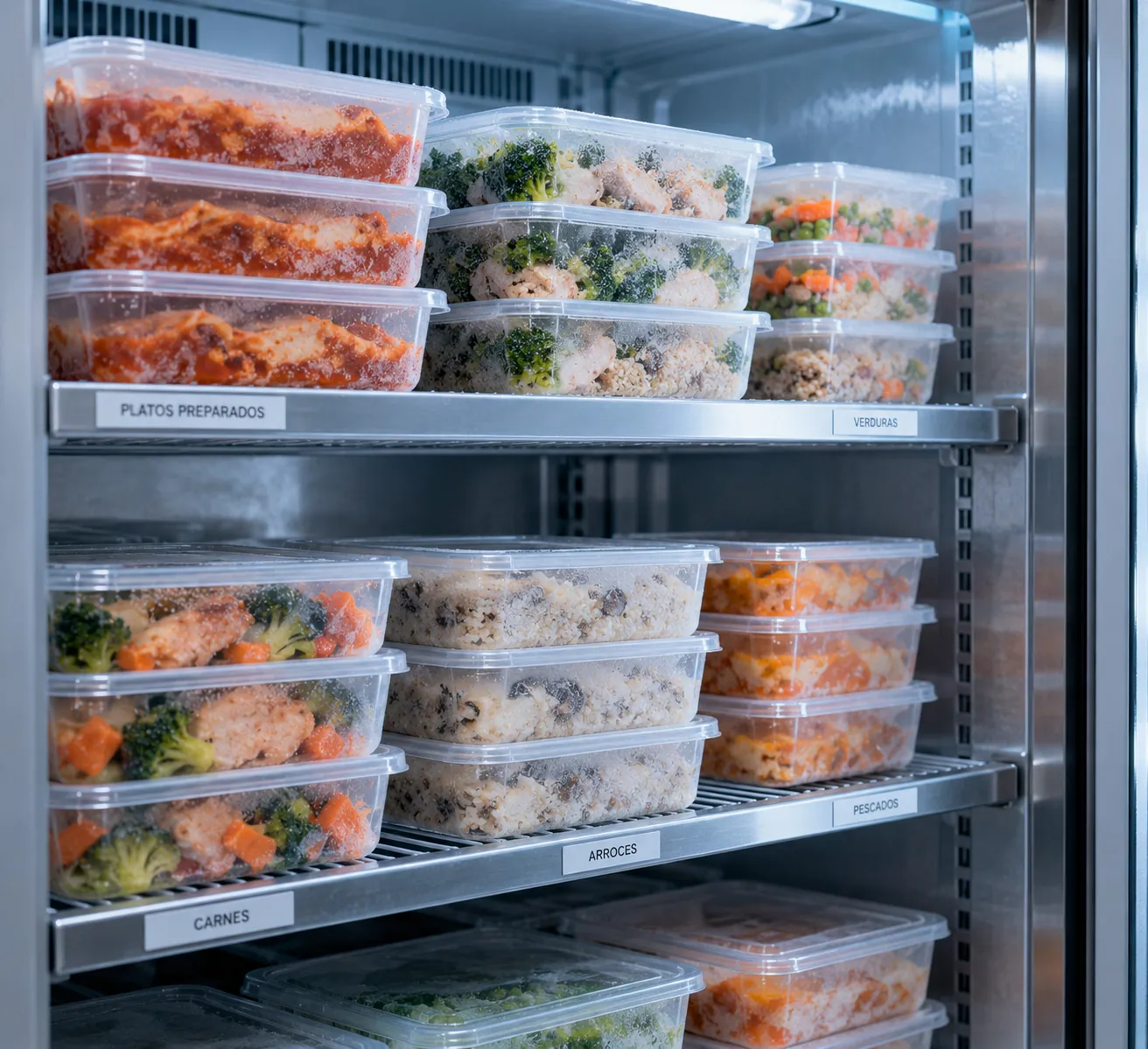
Delivery packaging and freezer use: how to choose containers for prepared food
Packaging performance at low temperatures must also be taken into account.
For production kitchens, caterers, central kitchens, prepared meal services and businesses working with advance production, containers for freezing food can play an important role in day-to-day operations.
The container must maintain its properties at low temperatures
Low temperatures can affect the behaviour of certain materials.
A container intended for freezing should retain its structural integrity, close correctly and protect the food properly during storage and subsequent handling.
It is therefore not enough that the container simply fits inside a freezer.
You need to check that the model is suitable for the expected cold-storage conditions.
Freezing food in the final container can reduce handling
For some services, it may be useful to prepare the food and store it directly in the same container in which it will later reach the customer.
The process might be:
production → packing → freezing → storage → sale.
This can help reduce certain internal handling steps.
Before introducing this type of system, however, it is worth considering:
- Resistance to low temperatures.
- Lid compatibility.
- Ease of stacking.
- Space required in cold rooms and freezers.
- Performance during handling.
- The defrosting process.
- The subsequent reheating method.
The packaging must perform correctly throughout the entire journey of the food, not only during freezing.
How to choose delivery packaging by temperature and food type
There is no single material that is suitable for every application.
Each packaging family offers different properties, and performance can also vary between different products made from the same material.
PP or polypropylene containers
Polypropylene containers are commonly used for prepared meals, foodservice and takeaway.
Some products are designed for hot foods, while others are suitable for particular reheating processes.
There may also be options compatible with low temperatures.
PP can therefore be useful for applications such as:
- Prepared meals.
- Hot takeaway menus.
- Chilled dishes.
- Rice and pasta.
- Meals that will later be reheated by the customer.
However, the conditions of use should never be assumed simply because the container is made from PP.


The specific product must confirm the required performance.
PET containers
PET is particularly common where good visibility of the food is important.
Salads, prepared fruit, sushi, bakery products and other cold foods are typical examples.
When the product journey mainly involves refrigeration, transport and cold consumption, PET can be a particularly useful solution.
If the food will later need to be heated, however, you should check whether the container is designed for that purpose or choose a more appropriate material.


Aluminium containers
Aluminium is commonly associated with prepared food, oven use and certain food storage applications.
It can be practical when the same container needs to form part of both the preparation process and the subsequent transport stage.
Compatibility with any heating method should always be checked against the manufacturer’s instructions.
The properties of one aluminium container should not automatically be applied to every other product made from the same material.


Cardboard, paper and plant-fibre packaging
This category includes a wide range of solutions.
Some containers are designed solely for holding and transporting food, while others are manufactured to withstand specific temperatures or treatments.
There are formats for hot foods as well as products that may be suitable for reheating under certain conditions.
Therefore:
“Made from cardboard” or “made from plant fibre” does not automatically imply a particular level of heat resistance.
The technical product information remains essential.


Do not choose the container alone: the base and lid must work together
For a delivery order, packaging should be considered as a complete system.
The base, lid and closure may be made from different materials and have different requirements.
Check every component before defining the instructions
Imagine that the base of the container is suitable for microwave use, but the transparent lid is not.
Simply telling the customer that “the packaging is microwave-safe” would be incomplete.
You may need to specify:
Remove the lid before reheating.
Leave the lid partially open to allow steam to escape.
Do not place certain components in the oven.
The simpler the instructions, the lower the risk of incorrect use.
Temperature, leak resistance and food type must be assessed together
Thermal resistance is not the only consideration.
Packaging for home delivery should also meet other requirements, such as:
- Preventing leaks.
- Protecting the food.
- Resisting grease or moisture where necessary.
- Making transport easier.
- Allowing efficient stacking.
- Maintaining an appropriate presentation.
A container may offer excellent heat resistance and still be unsuitable for soup or a very runny sauce.
That is why thermal treatment and the characteristics of the food must be assessed together.
Which packaging does your business need in each situation?
This table can be used as an initial guide:
| Situation | What the business should prioritise |
|---|---|
| The customer will reheat the meal in a microwave | Explicit microwave compatibility, lid performance and ease of use |
| The dish needs to go in the oven | A container specifically designed for oven use, with suitable time and temperature conditions |
| The prepared meal will be frozen | Compatibility with low temperatures, secure closure and resistance during storage |
| Hot food delivery | Heat resistance, secure closure, stability and steam management |
| Cold or chilled food | Preservation, presentation, closure and performance at low temperatures |
| Food containing sauces or liquids | Leak resistance, closure and resistance to moisture and grease |
| Food going through several stages | Compatibility with the entire process or a clearly defined procedure for changing containers |
Instead of asking:
“What is the best packaging for delivery?”
it is often more useful to ask:
“Which container is right for the specific process this dish will go through?”
Common mistakes when choosing delivery packaging by temperature
Assuming that all containers made from the same material are identical
Two containers made from the same material do not necessarily have exactly the same technical specifications.
Conditions of use must be checked for each individual product.
Confusing hot food with oven use
A container that can hold freshly prepared hot food may not be able to withstand an oven cycle.
These are different thermal conditions.
Forgetting to check the lid
The base may be suitable for a particular use while the lid needs to be removed first.
Trying to use the same container for the entire menu
Reducing the number of packaging references can simplify purchasing and storage.
However, soup, a cold salad, lasagne and a microwave meal all have very different requirements.
Standardisation is useful when those requirements are genuinely compatible.
Failing to consider what happens after delivery
With delivery, the customer experience does not end when the courier collects the order.
The customer may refrigerate the meal, reheat it later or wait several hours before eating it.
The packaging should also be suitable for this stage.
Failing to test the packaging with the real product
Technical specifications are essential, but it is also advisable to test the container under conditions similar to those of the actual service.
Test the packaging before introducing it into your service
Before replacing a format or introducing a new container, it can be useful to carry out a simple internal test.
1. Use the actual dish
Do not test an empty container alone.
Fill it with the same quantity of food that will be used during normal service.
2. Reproduce the real temperature
If the food is packed immediately after preparation, carry out the test under the same conditions.
If it will be frozen, reproduce the expected freezing period as well.
3. Simulate delivery
Close the container, place it in the delivery bag and reproduce the movement and stacking that would occur during a real order.
Check for deformation, opening or leaks.
4. Simulate final use
Where the product is suitable for it, reproduce the process that the customer will follow:
- Microwave.
- Oven.
- Defrosting.
- Eating directly from the container.
Always remain within the conditions specified for the product.
5. Check the result
Assess:
- The condition of the container.
- The closure.
- Possible leaks.
- Ease of opening.
- Condensation.
- Presentation of the food.
- Stability of the packaging.
- Performance of the lid.
- Ease of eating.
6. Provide clear instructions
If the customer needs to remove a lid, open a valve or follow particular conditions before reheating, communicate this clearly.
Do not leave the customer to guess how the packaging should be used.
The technical data sheet should always have the final say
Understanding the general characteristics of PP, PET, aluminium, cardboard and plant fibres is useful when narrowing down the options.
However, these general properties do not replace the specifications of the individual product.
This is particularly important when considering:
- Microwave use.
- Oven use.
- Freezing.
- Maximum temperatures.
- Minimum temperatures.
- Exposure time.
- Contact with fatty foods.
- Contact with acidic foods.
- Reuse.
- Dishwasher use.
For a professional business, the rule should be simple:
If a thermal property is important for your service, check that it is explicitly stated for that particular packaging product.
Do not assume it solely from the material or appearance of the container.
Delivery packaging by temperature: let the intended use determine the material
Choosing the right delivery packaging by temperature is not about memorising which materials are generally associated with microwaves, ovens or freezers.
The most important thing is understanding the full journey of the food.
A restaurant delivering hot meals has one set of requirements.
A business selling weekly meal plans designed to be reheated later has another.
A production kitchen that freezes part of its output works with a different process.
And an establishment that prepares food directly in oven-safe containers needs different properties again.
Before choosing your packaging, define:
what food you will serve → which temperatures it will be exposed to → how it will be transported → how it will be stored → how the customer will use it.
From there, choosing the material, capacity, format and lid becomes much easier.
Because the best packaging is not necessarily the one with the greatest number of technical features.
It is the packaging that performs correctly throughout the food’s real journey while making the process easier for the business and improving the customer experience.