

A client meeting, training day, business breakfast or product presentation may have very different objectives, but they all have one thing in common: every detail influences the experience of those attending. And when food or drink is involved, choosing the right tableware and accessories is one of those details that should not be left until the last minute.
In corporate catering, choosing the right catering tableware is essential: plates, cups, cutlery, trays, napkins and containers are not simply accessories. They need to make service easier, suit the menu, fit the available space and convey an image that reflects the company.
The good news is that there is no need to overcomplicate things. If you know what type of event you are organising and how guests will eat and drink, it becomes much easier to decide what tableware you need and avoid buying products that turn out to be impractical.
Why is choosing the right tableware important for corporate catering?
Business events often have a very different pace from a traditional meal. Guests may be arriving and leaving at different times, talking while standing, working with a break of only twenty minutes or taking part in a meeting that should be interrupted as little as possible.
The tableware needs to work with that rhythm.
For example, a large, heavy plate may work perfectly well for a seated lunch but be inconvenient during a networking reception. Similarly, an elegant cup may be ideal for an executive meeting, while a cup with a lid may be far more practical for breakfast during a training day.
Choosing well can help to:
- speed up set-up and clearing away;
- allow guests to eat and drink comfortably;
- reduce spills and accidents;
- improve food presentation;
- maintain a consistent look throughout the event;
- optimise quantities and budget;
- avoid using unnecessary materials.
The aim should not be to use as much tableware as possible, but to have exactly the items required for each type of service.
Before choosing: consider what the event will be like
To organise corporate catering properly, it is important to define the needs of the event before selecting the tableware.
Before filling your basket with plates, cups and cutlery, it is worth answering five questions.
How many people will be attending?
The number of guests determines the quantities you need, but it can also affect the way the service itself is organised.
A meeting for ten people allows you to prepare a table with each place carefully arranged. At an event for one hundred people, however, creating several self-service stations may be far more efficient.
It is also sensible to add a small margin above the expected number of attendees to cover last-minute arrivals, items that are dropped or higher consumption than expected.
Will guests be seated or standing?
This question affects a large part of your tableware selection.
For eating while standing, smaller plates, easy-to-hold containers, practical cups and dishes that require little cutlery usually work best.
If every guest has a seat at a table, you can use larger plates and create a more complete table setting.
What food and drinks will be served?
The menu should always be chosen before the tableware.
A pastry, creamy soup, salad, dish with sauce or hot appetiser will not require the same type of container. You should also check the specific characteristics of each product if you need particular resistance to grease, liquids or certain temperatures.
In addition, any material intended to come into contact with food must comply with the applicable regulations for materials that come into contact with food. It is therefore important to check the stated conditions of use for each individual product.
The same applies to drinks. Coffee, water, soft drinks, wine and cocktails all require different types and sizes of cups or glasses.
How long will the catering service last?
During a fifteen-minute coffee break, speed is usually the main priority.
During an eight-hour training day, however, you may have breakfast, drinks throughout the morning, lunch and another break in the afternoon. In that case, it makes sense to calculate the required tableware for each stage of the day to avoid both shortages and unnecessary excess.
What image do you want to convey?
Corporate catering also forms part of the overall presentation of an event.
A product launch, internal meeting and reception for important clients may each require a different level of formality.
Colour, material, finish and design can help you adapt the table to the occasion without needing an elaborate set-up.
What tableware should you choose for different types of corporate catering?
There is no single type of tableware that works perfectly for every event. The right choice depends mainly on how attendees are going to interact with the food.
Meetings and business breakfasts
During a meeting, catering should remain in the background and avoid interrupting the conversation.
For coffee, pastries, fruit or small bites, you may need:
- cups for hot drinks;
- cups or glasses for water and cold drinks;
- small plates;
- smaller napkins;
- trays for presenting food;
- teaspoons or stirrers where necessary.
A useful tip is to avoid items that are too large. The more compact the table set-up, the more space guests will have for laptops, documents and other work materials.
Coffee breaks and training days
For corporate catering organised as a coffee break, speed and a smooth flow of guests are essential. Attendees usually have limited time, so it helps to create a simple route: drink, food, napkin and move on.
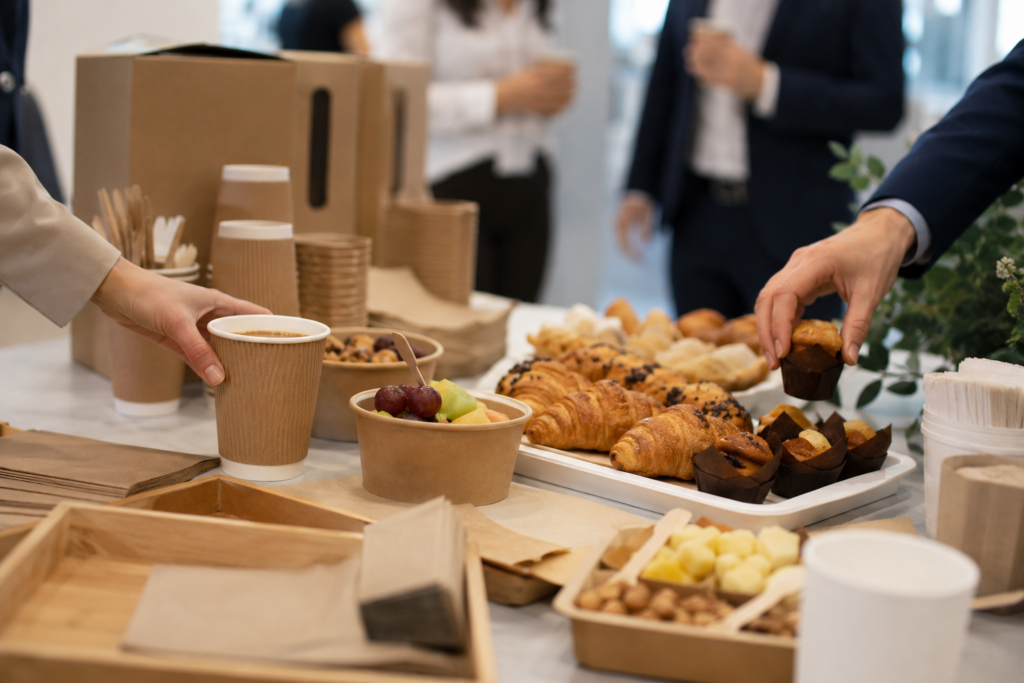
Small plates, easy-to-carry cups and finger food can help reduce queues. When there are large numbers of attendees, it can also be useful to create several service points.
If the programme continues after the break, pay particular attention to waste and collection areas. A well-organised space prevents used cups and napkins from being left around the room.
Business lunches and longer meetings
When the catering replaces a complete meal, the tableware needs to provide a little more comfort.
You may need:
- dinner plates;
- smaller plates or containers for starters;
- cutlery;
- cups or glasses;
- larger napkins;
- trays and serving platters for sharing;
- small containers for sauces or side dishes.
For buffet-style service, choose plates that are sturdy but still comfortable to carry in one hand.
It is also best to avoid filling plates with too many small individual items that force guests to make several trips between the buffet and their table.
Receptions, presentations and networking events
This is probably the type of event where tableware plays the most visible role.
Catering miniatures, small cups, side plates, tasting spoons, cones and individual containers make it possible to present a variety of dishes attractively without setting a traditional dining table.
With this type of corporate catering, one particularly useful rule applies: guests should be able to eat comfortably while continuing a conversation.
If someone needs a plate, knife, fork and a table simply to enjoy one appetiser, the format may not be the most suitable for an event where people are moving around.
Which material should you choose for the tableware?
Once you have decided on the format, there is another important choice to make: the material.
There is no single material that is automatically best for every situation. You need to consider appearance, strength, type of food, whether reuse is required and the conditions of service.
The choice of material for corporate catering therefore depends just as much on the menu as it does on the style of service and the image you want to create.
Cardboard and kraft
Cardboard formats are widely used for breakfasts, coffee breaks, tastings and more informal catering services.
Their simple appearance works particularly well for events seeking a modern and functional presentation. There are also plates, cups, food trays and many other types of containers available in a wide range of designs.
Always check the specifications of each individual product, particularly when serving liquids, greasy foods or hot dishes.
Reusable tableware
If you want a more refined presentation without necessarily using traditional crockery, reusable plates, cups and glasses can be an interesting option.
They work well for recurring events, company celebrations, receptions and services where appearance is particularly important.
Before choosing them, remember that you will also need to organise collection, storage and cleaning.
Pulp and plant fibres
Containers made from plant fibres have a natural appearance and are available in plates, bowls, trays and a wide variety of other formats.
They can be particularly useful when you want to combine a simple presentation with sturdy, functional products.
As with any material, suitability for higher temperatures, microwave use, liquids or greasy foods depends on the specific product and should always be checked before use.
Wood and bamboo
Picks, skewers, cutlery and small presentation accessories made from wood or bamboo can bring a natural finish to the overall set-up.
They are especially useful for tastings, appetisers and smaller portions.



Presentation communicates too
Imagine two companies serving exactly the same menu.
The first uses plates, cups and napkins with no consistent visual approach. The second maintains the same colour palette, uses containers that are properly proportioned to each dish and arranges the table neatly.
The food may be identical, but the perception of the event can be completely different.

There is no need to personalise every individual item with a logo to achieve a consistent presentation. Sometimes it is enough to work with a defined colour palette, maintain the same style of tableware and limit the number of different materials being used.
At commercial meetings or product presentations, this consistency becomes even more important because corporate catering becomes an extension of the image the company wants to convey.
How do you calculate how much tableware you need?
Ordering too much means unnecessary expense. Ordering too little can become a problem halfway through the event.
With corporate catering, planning quantities in advance helps prevent both shortages during service and unnecessary purchases.
A simple formula to start with is:
Number of attendees × expected consumption per person + safety margin.
Expected consumption depends on the type of event.
During a coffee break, one small plate per person may be enough, while cups may have a higher turnover if several drinks are served throughout the day.
Napkins also tend to be used more frequently than plates.
Before placing an order, prepare a simple table covering:
- number of attendees;
- different food and drink moments;
- plates required for each service;
- cups or glasses according to each drink;
- cutlery based on the menu;
- napkins;
- additional containers and accessories;
- an extra safety margin.
This simple bit of planning can prevent a great deal of last-minute purchasing.
A simple example
Imagine a meeting for 50 people where coffee, water, juice, pastries and fruit will be served.
Rather than automatically ordering fifty of every item, think about how each one will actually be used.
Each guest will probably need one plate, but may have more than one drink. Napkins are also likely to be used more frequently than plates.
Your calculation should reflect these patterns of consumption before adding a reasonable margin for unexpected needs.
Common mistakes when preparing tableware for a business event
Several common mistakes are easy to avoid.
Choosing appearance before practicality
A container may look very attractive while still being impractical for the food you want to serve.
Choose the menu and serving format first. Consider the design afterwards.
Using plates that are too large
This is especially common at receptions and events where guests are eating while standing.
A container that is proportionate to the serving size is usually more comfortable and can also improve the presentation of the food.
Forgetting small accessories
Teaspoons, stirrers, lids, napkins, picks and sauce containers may seem like minor details until they are missing.
Include them in your planning from the beginning.
Mixing too many styles
A little variety can add interest to the presentation. Too much can make the table look unplanned.
Try to maintain a consistent approach to materials, colours and shapes.
Forgetting about clearing away
The event does not end when the last plate has been served.
Decide in advance where used tableware will be placed, how different types of waste will be separated and who will be responsible for clearing each area.
Checklist for preparing tableware for your next corporate catering event
Before placing your order, make sure your corporate catering is properly planned by reviewing the following points:
- How many attendees are expected?
- Will guests be seated or standing?
- What is on the menu?
- What drinks will be served?
- Will there be one or several catering services during the day?
- Do you need containers for hot, cold, liquid or greasy foods?
- Will guests have a table where they can place their plate?
- Do you need lids or solutions for transporting food?
- How formal does the event need to be?
- Do you want to maintain a particular style or colour palette?
- Have you included napkins, cutlery and smaller accessories?
- Have you allowed for an additional safety margin?
- How will used items be collected at the end of the event?
If you can answer all these questions, you probably already have a fairly clear idea of what you need.
The best tableware makes the event easier
Good corporate catering is not about filling a table with as many products as possible. It is about making sure everything works naturally and efficiently.
The plate should suit the food. The cup should suit the drink. The size of each item should suit the way guests move around the event. And the overall set-up should reflect the image and level of formality the company wants to convey.
When tableware is chosen well, it rarely draws attention to itself. It simply makes it easy for people to eat, drink, talk and continue with the event.
And that feeling that everything works exactly as it should is one of the clearest signs of a well-planned business event.